From Chaos to Coherence: The Essence of Diffusion
At the forefront of the generative AI revolution are diffusion models, a class of algorithms that have captured the world with their ability to create stunningly realistic and imaginative content from simple text prompts. While often associated with image generation tools like DALL-E and Stable Diffusion, their power lies in a fascinating and broadly applicable process inspired by thermodynamics: the gradual transformation of random noise into a coherent, structured output through a series of refinement steps.
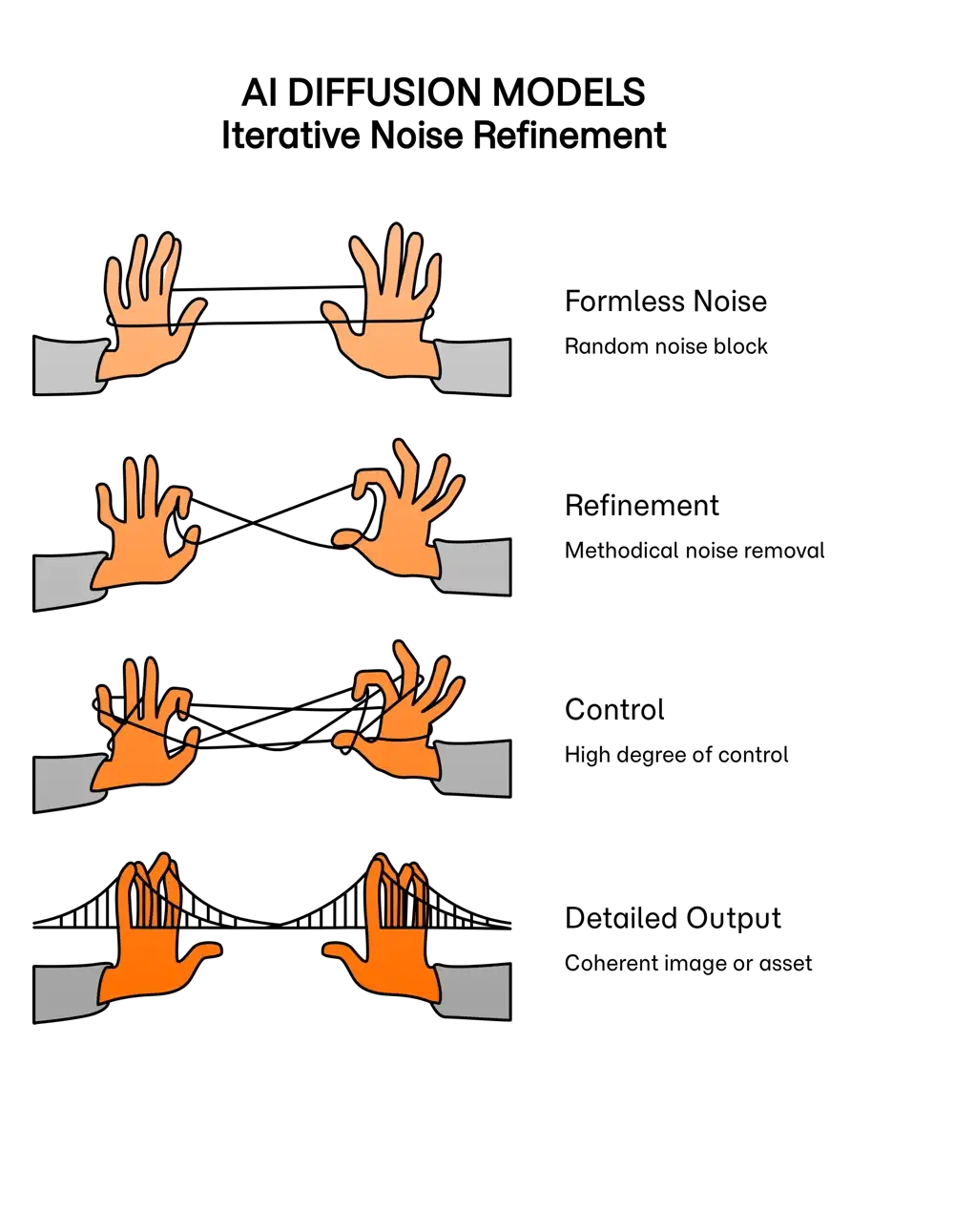
The core principle of a diffusion model is a two-part process. First, in the "forward diffusion process," the model is trained by taking clear data be it an image, an audio clip, or a molecular structure and progressively adding small amounts of Gaussian noise over many steps until the data becomes indistinguishable from pure static. The model meticulously learns to reverse this degradation. Then, the magic happens in the "reverse diffusion process." Here, the machine learning model learns to undo the noise, step-by-step. Starting with a completely random noise pattern, it iteratively predicts and removes the noise, gradually refining the chaos into a structured and detailed output. This iterative denoising is the key to their remarkable and versatile capabilities.
The Universal Blueprint: Iterative Refinement Across Domains
The iterative noise refinement process is a powerful and flexible paradigm that extends far beyond generating images. This method of starting with randomness and progressively imposing structure is being adapted for a wide array of data types. The core prompt AI-process remains the same, but the "data" being denoised changes, unlocking new creative and scientific frontiers. This approach is often more stable than other generative methods like GANs, avoiding issues like mode collapse and enabling more diverse outputs.
By adjusting the denoising schedule and conditioning the process on specific inputs (like a what is a prompt), users can guide the generation toward a desired outcome with a high degree of control. This has led to breakthroughs in fields as diverse as audio synthesis, text generation, video creation, and 3D modeling.
Applications in Creative Media
The step-by-step refinement process has revolutionized digital artistry and content creation. It provides a highly controllable and versatile tool for generating novel content across different media.
| Media Type | Application of Iterative Denoising |
|---|---|
| Image & Art Generation | This is the most well-known application. The process is akin to a digital artist starting with a blank canvas (noise) and gradually adding layers of detail to create photorealistic or stylized images. This method is used for everything from prompt for advertising to creating authentic portraits. |
| Audio & Music Synthesis | For audio, the model denoises a random signal into a structured waveform. This can be used for high-fidelity text-to-speech, creating realistic sound effects, or generating novel musical compositions. The model learns to form coherent audio from noise by treating audio data, often represented as spectrograms, like 2D images. |
| Video Generation | Video generation extends the 2D image process by adding a time dimension. The model must denoise a sequence of frames while maintaining temporal consistency. This is achieved using techniques like 3D convolutions and attention mechanisms that ensure objects and scenes evolve coherently over time. |
| 3D Model Generation | In this domain, diffusion models generate 3D shapes by refining point clouds, voxel grids, or other 3D representations from an initial noisy state. This is used to create detailed 3D assets for gaming, virtual reality, and design, often guided by text or a single 2D image. |
A New Paradigm for Scientific and Technical Problems
The iterative refinement at the heart of diffusion models is now being explored as a powerful paradigm for solving complex problems in science and engineering. Researchers are reframing optimisation and design challenges as a process of "denoising" a random state into an optimal solution, often guided by specific constraints or reward functions.
| Scientific Field | Application of Iterative Denoising |
|---|---|
| Drug Discovery & Molecular Design | Scientists use diffusion models to generate novel 3D molecular structures. Starting with a random arrangement of atoms, the model, guided by chemical and physical principles, iteratively refines the structure to create stable molecules with desired properties for new drugs. |
| Text Generation & NLP | In Natural Language Processing, diffusion models can generate text by starting with random vectors and iteratively denoising them into coherent word embeddings. This non-autoregressive approach allows for parallel processing and can offer more flexibility and error correction than traditional left-to-right generation methods. |
| Data Imputation & Forecasting | The denoising process is effective for filling in missing data in time-series, such as from medical sensors or financial markets. The model can "denoise" a partial or corrupted dataset to predict missing values or forecast future trends by capturing the underlying data distribution. |
Deconstructing Complexity: Diffusion Models as Educational Tools
The transparent, step-by-step nature of the generation process makes diffusion models a uniquely effective tool for education. Unlike some "black box" artificial intelligence models where the inner workings are opaque, the iterative refinement of a diffusion model is highly visual and intuitive. One can literally watch as a recognisable output emerges from a field of static over dozens or hundreds of steps. This gradual transformation demystifies the creation process and provides a tangible way to understand prompt and complex concepts.
Educational courses are now being designed around building diffusion models from the ground up. This hands-on approach allows students to engage with core principles of artificial neural networks, probability theory, and stochastic processes in a practical way. By breaking down the seemingly magical process of AI generation into a series of logical, understandable steps, diffusion models serve as a powerful educational driver, making advanced AI concepts more accessible and fostering a deeper understanding of how these transformative technologies work.
Ready to transform your AI into a genius, all for Free?
Create your prompt. Writing it in your voice and style.
Click the Prompt Rocket button.
Receive your Better Prompt in seconds.
Choose your favorite AI model and click to share.
Summary of AI Image Diffusion Models
The iterative noise refinement process is the core mechanism that allows diffusion models to generate high-quality, novel data across numerous domains. This process starts with a sample composed entirely of random noise. The model then progressively denoises the sample in a series of steps. In each step, it predicts and removes some of the noise, gradually adding structure and detail until a coherent output emerges. This methodical refinement is what enables the creation of complex, realistic, and diverse outputs, making it a foundational technology in modern generative AI.