A wave of artificially intelligent creativity is washing over the digital landscape, breathing new life into our collective cultural memory. From the grainy textures of old photographs to the iconic scenes of classic cinema, generative AI is emerging as a powerful tool for reimagining existing media. By leveraging "nostalgic scenarios," creators can transpose familiar content into a vast array of artistic styles and historical periods, offering audiences a fresh and often mesmerizing perspective on the media they know and love. These tools can transform modern photos with a vintage aesthetic or even animate old family pictures to create moving videos.
The Heart of Reimagination: How AI Creates Nostalgic Scenarios
At the core of this movement are generative AI models, such as diffusion models, which are sophisticated algorithms trained on immense datasets of images and text. These AIs can identify and understand the fundamental elements of a piece of media like its content and separate them from its aesthetic qualities, or its style. This process, known as neural style transfer (NST), allows a user to take a piece of media, such as a video clip or a photograph, and apply the visual characteristics of another. The AI essentially learns the "artistic DNA" of a style, be it the swirling brushstrokes of Van Gogh or the crisp lines of a comic book, and then rebuilds the original content using these new artistic instructions.
The creation of these nostalgic scenarios often begins with a simple text-to-image prompt. A user might describe a memory or a desired aesthetic, such as "a 1950s diner with neon lights and classic cars" or "a quiet suburban street in the 1980s during a summer evening". The more detailed the prompt, the better the AI can capture the specific mood, era, and visual elements, generating a unique piece of nostalgic art from scratch. This process allows for endless creative experimentation.
This same technology can be applied to existing media. Imagine taking a scene from a modern blockbuster and rendering it in the style of a 1940s film noir, or transforming a family photo into a Renaissance-era portrait. This is not simply a filter; the AI analyzes the content and intelligently redraws it in the new style, preserving the subject matter while completely altering its look and feel.
A Journey Through Art and Time: Diverse Styles and Historical Periods
The creative possibilities unlocked by AI are vast, spanning the entire history of art and visual media. AI art generators now offer a plethora of styles, from the soft, light-filled brushstrokes of Impressionism to the bold geometric shapes of Art Deco. Creators can experiment with a multitude of artistic movements, including Art Nouveau, Surrealism, and Cubism, to see their favorite media in a completely new light.
Beyond fine art, AI can also replicate the look and feel of specific historical periods in photography and film. It's possible to transform a modern digital photograph into a wet-plate collodion print from the 1850s or a gum bichromate print from the 1890s, capturing the unique vintage aesthetics of these early photographic processes. Similarly, video footage can be stylized to mimic the aesthetic of different cinematic eras, complete with the appropriate colour palettes, grain, and lighting.
From Classic Films to Personal Memories: Reimagining Our Visual World
The application of these AI-driven nostalgic scenarios is already making a significant impact on the media and entertainment industry. For example, the classic 1939 film "The Wizard of Oz" was reimagined for an immersive experience at the Las Vegas Sphere. AI was used to enhance the resolution and expand the original footage to fit the massive, curved screen through a process called outpainting, where the AI generates new imagery around the edges of the original shots. This has sparked debate about when enhancement becomes erasure of the original art.
In another ambitious project, a startup is using generative AI to recreate the 43 minutes of lost footage from Orson Welles' 1942 classic, "The Magnificent Ambersons". By training an AI on the existing film, scripts, and other historical data, the team aims to give audiences a glimpse of the director's original vision. Such AI-powered film restoration can also be used to remove scratches, restore color, and enhance audio on historical films.
Beyond the world of professional filmmaking, everyday users are also embracing these tools to reimagine their own media. AI-powered apps and software allow individuals to transform their personal photos and videos into a wide range of artistic styles. With just a few clicks, a simple portrait can become a dreamy watercolor, and a home video can be stylized to look like a Ghibli-style animation. These tools are democratizing the creative process, allowing anyone to experiment with visual storytelling in ways that were previously unimaginable.
The Creative Workflow: A New Partnership Between Human and Machine
While the results can seem magical, the process of using AI to reimagine media is becoming an increasingly integral part of creative workflows. It is not about replacing human creativity, but augmenting it. Artists, designers, and filmmakers are using AI as a powerful assistant for tasks like rapid prototyping, experimenting with different visual approaches, and automating time-consuming processes. This requires skill in creative prompting to achieve the desired results.
The typical workflow for video style transfer, for example, involves the AI analyzing the content of the video and the desired art style from a reference image or prompt. The AI then applies the style to the original video while ensuring frame-to-frame consistency to avoid a flickering effect. This allows creators to explore different aesthetics for a project quickly and efficiently, sometimes managing their prompts in dedicated prompt libraries.
In essence, we are witnessing the rise of a new creative partnership. AI can generate ideas, execute complex stylistic transformations, and open up new artistic possibilities, while humans provide the vision, curation, and emotional depth that give the final product meaning. This collaboration, a key part of modern prompt engineering, is pushing the boundaries of what is possible in media creation, allowing us to not only look back at our visual history with a sense of nostalgia but also to actively and creatively engage with it in the present.
Ready to transform your AI into a genius, all for Free?
Create your prompt. Writing it in your voice and style.
Click the Prompt Rocket button.
Receive your Better Prompt in seconds.
Choose your favorite AI model and click to share.
Summary of Nostalgic Scenarios
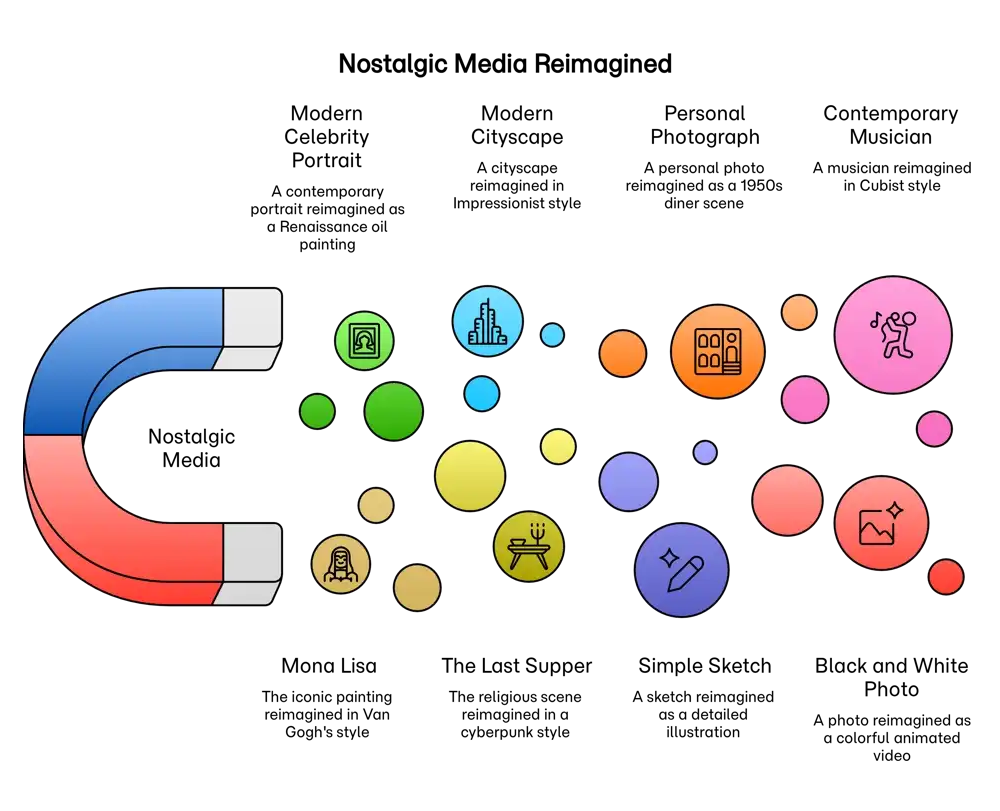
Artificial intelligence is revolutionizing the way we reimagine existing media, allowing creators and audiences to experience familiar content through the filter of different artistic styles and historical periods. By leveraging AI image generators, it's possible to create nostalgic scenarios that transport iconic characters, scenes, and aesthetics into new visual contexts. This is often achieved through a process called neural style transfer, where an AI model applies the stylistic elements of one image, such as the brushstrokes of a famous painter or the grainy texture of vintage film, to another. This technology enables the exploration of countless creative possibilities, from envisioning a modern cityscape in the style of an Impressionist painting to rendering a contemporary celebrity as a Renaissance portrait. The ability to generate these visual scenarios opens up new avenues for artistic expression, allowing for a dynamic dialogue between past and present, and fostering a deeper appreciation for the original media and the new styles being emulated.
Reimagining Art & Media
| Existing Media / Concept | Artistic Style / Historical Period Reimagined | Resulting AI-Generated Visual Scenario |
|---|---|---|
| Modern Celebrity Portrait | Renaissance Oil Painting | A portrait of a contemporary celebrity with the dramatic lighting, rich colors, and textured canvas characteristic of the Renaissance era. |
| "Mona Lisa" by Leonardo da Vinci | Vincent van Gogh's "Starry Night" Style | An AI-generated image that reinterprets the Mona Lisa with the swirling, vibrant brushstrokes and celestial patterns of "Starry Night". |
| "The Last Supper" by Leonardo da Vinci | Cyberpunk / Futuristic | A re-creation of the iconic religious scene with cybernetic figures, neon lighting, and a dystopian, high-tech setting. |
| Contemporary Musician | Cubism (Picasso-esque) | A portrait of a modern musician depicted with fragmented planes, bold colors, and the multi-perspective view typical of Picasso's Cubist works. |
Creating Historical & Personal Scenarios
| Existing Media / Concept | Artistic Style / Historical Period Reimagined | Resulting AI-Generated Visual Scenario |
|---|---|---|
| Modern Cityscape | Impressionism (Monet-inspired) | A cityscape rendered with soft light, visible brushstrokes, and a focus on the changing qualities of light, reminiscent of Claude Monet's work. |
| A personal photograph | 1950s Diner Scene | The photograph's subjects are placed within a classic 1950s diner, complete with neon lights, retro furniture, and classic cars outside. |
| Black and White Historical Photo | Animated Video with Colorization | AI animates the faces in a static historical photograph, adding subtle movements and colour to bring the subjects to life. |
| A simple sketch | Detailed Illustration | An AI tool transforms a basic drawing into a fully rendered illustration with depth, color, and texture. |