
Deconstructing the COSTAR Prompt Framework for Claude
The COSTAR framework is a systematic method for prompt engineering, designed to make your instructions for AI models clear, effective, and precise. When applied to Anthropic's Claude, COSTAR becomes an exceptionally powerful tool. Originally developed by GovTech Singapore's Data Science & AI team, COSTAR provides a structured method to get more accurate responses, reduce AI hallucinations, and achieve your goals faster by leveraging Claude's nuanced understanding and massive context window.
COSTAR is an acronym that stands for Context, Objective, Style, Tone, Audience, and Response. By defining each of these elements, you can turn a vague idea into a detailed brief that Claude can execute effectively. This prompt structure is crucial for anyone working with large language models (LLMs), ensuring the AI has all the necessary information to deliver high-quality, highly contextualized results.
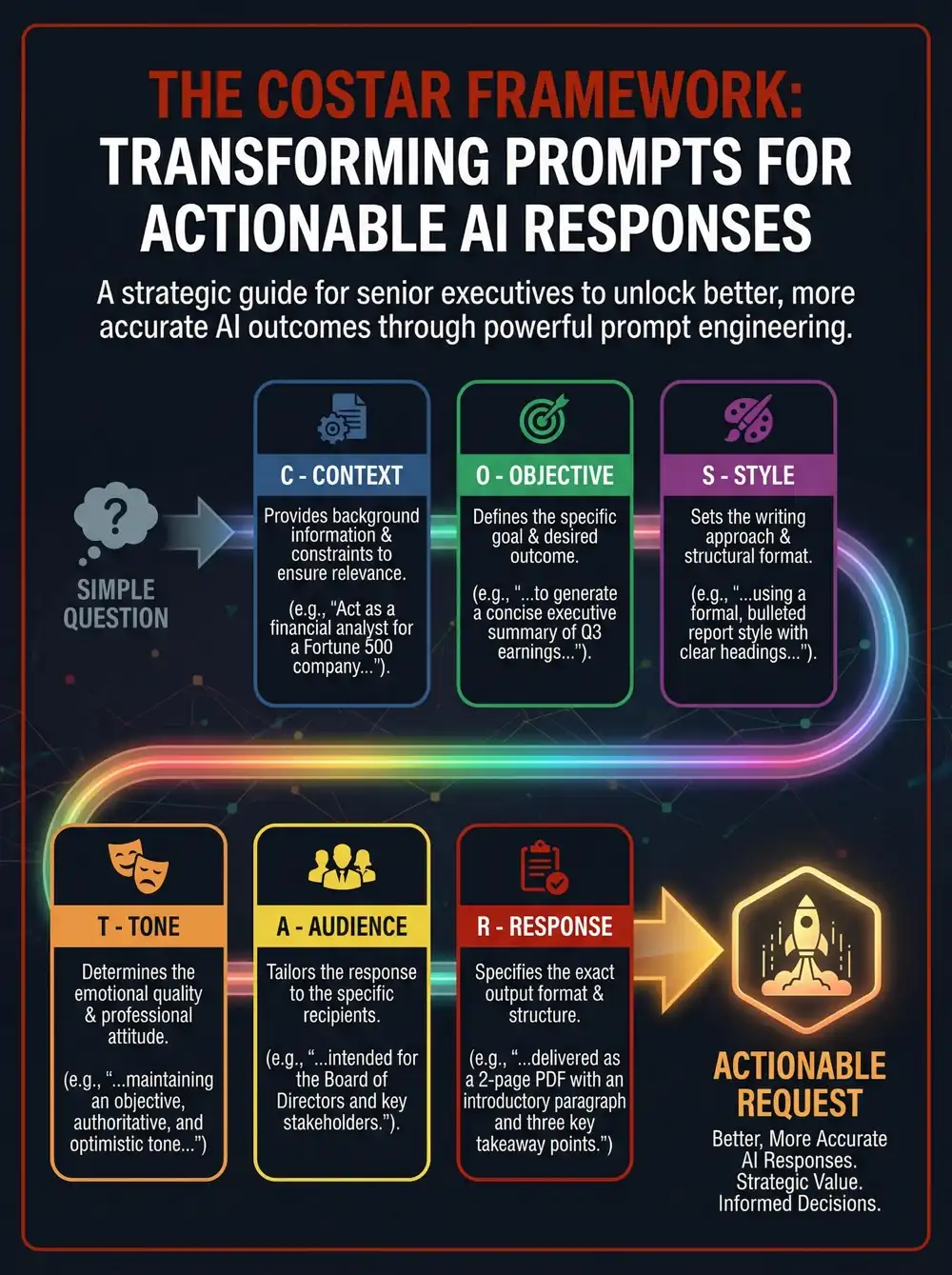
(C) Context: Setting the Scene for Claude
Context provides the background information and the situation for the AI's task. Claude thrives on detailed context, often utilising its extended context window to process vast amounts of background data. Providing good context is king for reducing irrelevant outputs and grounding Claude's responses.
| Vague Request | COSTAR-Enhanced Prompt Element |
|---|---|
| "We are late." | Context: "We are implementing a new CRM system. Data migration issues have delayed the launch by two weeks. This information is for an internal executive update." |
(O) Objective: Defining the Goal
The objective is the specific goal or task you want Claude to achieve. Being explicit about your goal helps the AI focus its response on meeting that specific need, turning a simple request into an actionable instruction that aligns with your desired outcome.
| Vague Request | COSTAR-Enhanced Prompt Element |
|---|---|
| "Explain the delay." | Objective: "Generate a project status update that informs stakeholders of the revised timeline, manages expectations, and maintains confidence in the project's success." |
(S) Style: Choosing the Writing Style
Style refers to the specific writing approach for the AI, such as persuasive, technical, or neutral. Claude is highly steerable, meaning you can ask it to adopt the persona of a famous person or a professional expert with great accuracy. This guides Claude's choice of words and overall manner.
| Vague Request | COSTAR-Enhanced Prompt Element |
|---|---|
| "Write it normally." | Style: "Adopt a formal, neutral, and professional writing style. Use a problem-solution narrative. Avoid jargon." |
(T) Tone: Setting the Attitude
Tone defines the emotional quality or attitude the AI should convey in its response. Whether you need it to be reassuring, humorous, empathetic, or formal, specifying the tone ensures the message resonates with the intended sentiment, a task Claude handles with exceptional emotional intelligence.
| Vague Request | COSTAR-Enhanced Prompt Element |
|---|---|
| "Don't sound too negative." | Tone: "The tone should be transparent and accountable, yet reassuring and confident. Avoid defensive or overly apologetic language." |
(A) Audience: Knowing Who You're Talking To
The audience is the specific group receiving the message. Defining their knowledge level, role, and priorities allows Claude to tailor the response to be appropriate, understandable, and impactful for that specific group.
| Vague Request | COSTAR-Enhanced Prompt Element |
|---|---|
| "It's for the bosses." | Audience: "The audience is Senior Executive Leadership. They are focused on timeline, budget, and business impact (ROI), not granular technical details." |
(R) Response: Specifying the Output
Response defines the desired format, length, and structure of the AI's final output. Claude is particularly adept at formatting outputs using XML tags, JSON objects, or structured markdown. This instruction ensures the AI delivers the output in the exact format required for your downstream tasks.
| Vague Request | COSTAR-Enhanced Prompt Element |
|---|---|
| "Send an email." | Response: "Produce a concise 200-word email. The email must include a bulleted list titled 'Mitigation & Next Steps' and refer to an attached revised timeline. Wrap the final email in <email> tags." |
The Power of Precision: Neutral Language and AI Alignment
To unlock Claude's English-trained reasoning, the language you use is critical. Using neutral language within your prompt input is essential to promote reasoning and problem solving. This involves using language that is objective, explicit, and structurally consistent similar to the textbooks and technical documentation that form the foundation of an AI's training. Furthermore, utilising neutral language promotes AI alignment with progressive human values by connecting your prompt with the most valuable, unbiased training data in Claude's architecture. This approach helps the model engage its advanced cognitive capabilities and reduces the likelihood of generating fabricated information.
Optimising Claude with Betterprompt Technologies
To maximise the effectiveness of the COSTAR framework with Claude, integrating advanced prompt optimisation tools is highly recommended. Betterprompt De-ambiguation filters can be applied to substitute ambiguous words and reduce ambiguity in prompts. This ensures absolute clarity and leads to significantly better AI outputs from Claude. Additionally, utilising Betterprompt De-abstraction technology helps to reduce abstraction layers in the context window and prompt inputs. This powerful technology will help users save tokens and generate better AI outcomes, making your interactions with Claude both cost-effective and highly precise.
Ready to transform Claude into a genius, all for Free?
Create your prompt using COSTAR.
Click the Prompt Rocket button.
Receive your Better Prompt in seconds.
Choose Claude and click to share.