
From a sleek, minimalist office lobby to a vibrant and bustling retail store, artificial intelligence is revolutionizing how businesses visualise their environments. Generative-AI is no longer just an analytical tool; it's a powerful creative engine for generating high-quality visuals. AI-generated images are transforming the corporate landscape, giving marketers, designers, and project managers the power to create bespoke business settings that were once only possible through expensive photoshoots and CGI. This technological shift democratizes visual creation, drives significant prompt cost and time savings, and is reshaping creative roles within the enterprise.
Visualising the Corporate World: Environments for Every Business Need
The primary advantage of AI image generation is its incredible versatility. Using targeted text-to-image prompts, professionals can instantly create any business-related scene, customised to their specific requirements.
Strategic Imagery for Marketing and Sales
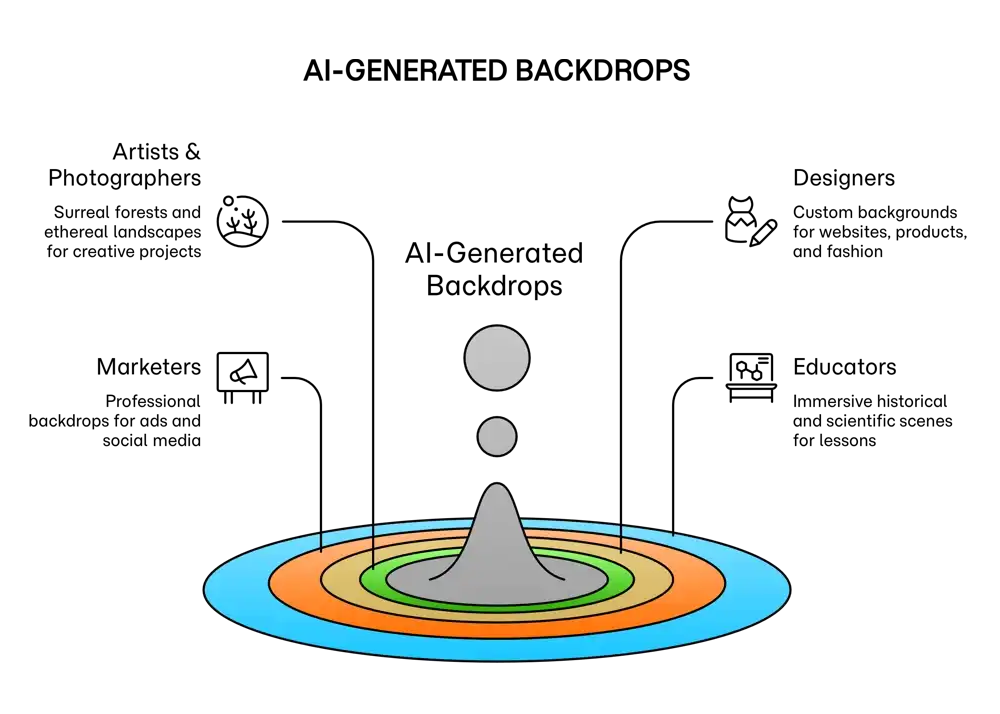
For marketing teams, the ability to generate hyper-realistic or stylized business environments is a major asset. Imagine creating a polished boardroom as a backdrop for a B2B service advertisement or a custom-branded retail interior to showcase a new product line. This can be done in minutes, avoiding the high costs and logistical challenges of securing and styling physical locations. E-commerce businesses can leverage AI to produce an endless variety of clean, professional, or contextual backgrounds for their product catalogs, significantly cutting photography expenses while boosting the visual appeal of their listings.
Concept Development and Prototyping for Design
Architects and interior designers are using AI to accelerate their workflows and bring ambitious concepts to life. AI tools can rapidly generate photorealistic renderings of proposed interior design prompts for offices, retail spaces, and hospitality venues. This speeds up the concept development and client presentation phases, enabling more creative exploration and faster iterations before committing to costly physical mockups or construction. It serves as a tireless brainstorming partner, providing visual inspiration for layouts, materials, and brand aesthetics.
Custom Backdrops for Corporate Communications
Within an organisation, teams can create custom visual aids tailored to their internal needs. An AI can generate a consistent set of branded backgrounds for company-wide presentations, a detailed diagram of a new factory workflow, or a welcoming image of a diverse team for an HR onboarding manual. This use of internal business content prompts enhances employee engagement and ensures brand consistency across all communications.
The Economic and Employment Potential
The adoption of AI-generated imagery is more than a creative update; it's an economic shift that is redefining industries and the future of professional creative work.
Economic Impact: Unprecedented Efficiency and Accessibility
The most significant economic benefit is a dramatic increase in efficiency. Tasks that once required days of coordinating photoshoots or manual design work can now be completed in seconds. This speed enables businesses, especially small businesses prompts, to produce more content, test more creative ideas, and respond more quickly to market trends. The cost savings are substantial, as companies can now access high-quality, custom visuals without a large budget. This democratization of visual creation allows smaller companies to compete with the sophisticated visual branding of larger corporations.
Employment Evolution: A Shift in Professional Roles
While concerns about job displacement exist, AI is primarily augmenting professional roles rather than replacing them. It automates the more tedious aspects of visual creation, freeing up professionals to concentrate on strategy, creative direction, and curation. The role of a designer or marketer is evolving from one of pure execution to that of a creative director who guides the AI, refines its output, and applies human insight to the final product.
This evolution is also creating entirely new jobs. "Prompt Engineers," who are experts at writing the detailed text descriptions that guide AI models, are in high demand. New roles like "AI Content Curator," "AI Ethics Officer," and "AI Trainer" are also emerging as essential positions that bridge creative vision with technological capability and responsible implementation. The future of professional work appears to be a collaborative one, where human creativity directs the power of artificial intelligence to achieve previously unimaginable results.
Ready to transform your AI into a genius, all for Free?
Create your prompt. Writing it in your voice and style.
Click the Prompt Rocket button.
Receive your Better Prompt in seconds.
Choose your favorite AI model and click to share.
Summary of AI-Generated Business Images
AI-generated imagery is revolutionizing the creation of custom business environments, offering marketers, designers, and corporate teams the ability to produce unique and specific visuals with remarkable speed and ease. From photorealistic office settings for ad campaigns to conceptual architectural visualisations for client pitches, generative AI can produce a vast range of business-centric scenes. This capability is unlocking significant economic and employment potential. For those in prompt for marketing, it dramatically reduces the time and expense tied to photoshoots and content creation, allowing for high-volume, targeted visuals. Architects and designers can use AI to rapidly prototype and visualise spaces, while corporate trainers can create bespoke images for more engaging learning materials. This technological shift is not only enhancing productivity but also creating a new job market for roles like prompt engineer and AI ethics analysts, who ensure these powerful tools are used responsibly.
Marketing & Advertising Applications
| Use Case | Visual Depiction Example | Business Benefit |
|---|---|---|
| Ad Creatives & Social Media | Polished office lobby with a company logo for a B2B campaign; a vibrant, branded café setting for a new beverage. | Enables rapid A/B testing of visuals; reduces dependency on costly photoshoots and location scouting. |
| Website & E-commerce | Custom hero images of a modern tech office; clean, studio-like backgrounds for product listings. | Enhances brand storytelling and visual consistency; improves product presentation to potentially increase sales. |
Design & Prototyping Applications
| Use Case | Visual Depiction Example | Business Benefit |
|---|---|---|
| Interior Design & Architecture | Photorealistic renders of a proposed office redesign; virtual walkthroughs of a new retail store concept. | Accelerates design iteration and client feedback loops; provides cost-effective concept exploration. |
| Product Visualisation | A new piece of furniture shown in various office styles (modern, industrial, etc.); a tech gadget on a futuristic desk. | Allows for contextual visualisation without physical prototypes; creates compelling visuals for investor pitches. |
Corporate & Educational Applications
| Use Case | Visual Depiction Example | Business Benefit |
|---|---|---|
| Internal Presentations | Branded backgrounds for virtual meetings; illustrations of a corporate team achieving a goal. | Ensures consistent internal branding; makes presentations more engaging and professional. |
| Training & Onboarding | Simulated factory floor to demonstrate a safety procedure; a visual diagram of the company's supply chain. | Creates accessible and high-quality custom visual aids; enhances learning retention and engagement. |