
A new frontier in digital creation is rapidly expanding, where language and visual art merge. This is the world of AI text-to-image generation, a revolutionary form of generative AI that translates written descriptions into complex imagery. At the heart of this transformation lies the essential skill of prompt engineering. This article explores how crafting detailed textual prompts dramatically impacts the quality of generated imagery across creative, academic, commercial, and technological fields.
From Text to Vision: The Dawn of a New Creative Era
AI text-to-image models are sophisticated machine learning systems, primarily diffusion models like DALL-E, Midjourney, and Stable Diffusion. Trained on vast datasets of images and text, they understand the connections between words and visual concepts, making the creation of high-quality visuals more accessible than ever before. This technology is not just a tool but a new medium for expression.
The Art of the Prompt: More Than Just Words
While the concept seems simple, the quality, style, and coherence of a generated image depend directly on the prompt. This is where the craft of a prompt engineer (part artist, part scientist) becomes critical. It involves carefully crafting prompts with a clear structure to guide the AI toward the desired output.
A well-crafted prompt includes several key elements to control the final image:
- Subject: The primary focus, described with specific and evocative adjectives.
- Style: The artistic direction, such as "photorealistic," "cyberpunk," or "in the style of an impressionist painter." Explore different options by choosing a style.
- Composition: The arrangement of elements, using terms like "wide shot," "macro shot," or "rule of thirds."
- Lighting: Descriptions like "dramatic rim lighting," "golden hour," or "soft studio light" to set the mood.
- Color Palette: Specifying a range of colors, like "vibrant neon colors" or "a muted, earthy palette."
- Technical Details: To achieve true realism, you can specify camera lenses, resolutions, or rendering engines.
Advanced techniques provide even greater control. Negative prompting, for example, allows users to specify what they *don't* want to see, helping to eliminate common imperfections or unwanted elements. The ability to give weight to certain words provides an additional layer of control, emphasising specific aspects of the desired output.
Applications Across Industries
The dynamic between user and AI is reshaping how professionals create and interact with visual content. Detailed prompts are key to unlocking high-quality, nuanced images tailored to the needs of each sector.
Creative Fields: A New Palette for Artists
For artists, designers, and filmmakers, text-to-image AI is a powerful tool for ideation and creation. Through creative prompting, they can rapidly prototype concepts, explore aesthetics, and generate complete works of art. An author, for instance, can generate stylistically consistent illustrations for a novel by defining character features, atmospheric lighting, and a specific "dreamy, painterly quality," bringing their narrative to life visually. This process extends human creativity rather than replacing it.
Academic and Educational Fields: Visualising the Abstract
In academia, AI makes complex information more engaging. Precise prompts are crucial for creating accurate historical scenes, illustrating abstract mathematical concepts, or producing scientifically accurate diagrams. A history teacher could use a detailed prompt like "A romantic, Renaissance-inspired scene featuring Romeo and Juliet in a moonlit garden, with ornate architecture and lush foliage," to create a visual aid that helps students connect with the play's themes and setting.
Commercial Fields: Tailoring the Message
In marketing and advertising, generating on-brand visuals quickly is a huge advantage. A marketing team can use a prompt like "A dynamic, modern illustration depicting business innovation and leadership...with a bold, graphic style" to create a unique campaign image that resonates with a target audience, all without a traditional photoshoot. For companies, including small businesses, this represents significant cost and time savings.
Technological Fields: Driving Innovation
In technology, prompts with highly technical language can control specific output parameters, including resolution, aspect ratios, and rendering techniques. A UI developer could generate a consistent icon set by specifying "minimalist, flat design, 2D vector style, on a transparent background." This is also essential for creating virtual environments, synthetic data for model training, and rapid image-to-image prototyping.
Achieving High Fidelity: The Importance of Prompt Adherence
The "textual-quality" of an image refers to the degree it faithfully represents the prompt's nuances. This is more than just including mentioned objects; it's about capturing mood, style, and underlying concepts. High prompt adherence is where skilled prompt engineering becomes vital. By learning to "speak the AI's language" with evocative and specific terminology, you can guide the model to a more accurate representation of your vision, transforming the process into a collaborative dance between human intent and the AI's interpretive capabilities.
Optimise Your Prompts in Seconds For Free
Tired of trial and error? Let our Prompt Optimiser refine your ideas into perfectly structured prompts for any AI model.
Write your idea. Use your own voice and style.
Click the Prompt Rocket button.
Get your Better Prompt in seconds.
Copy it and use it in your favorite AI image generator.
The Future of Co-Creation
The field of text-to-image generation is evolving at a breakneck pace. As technology advances, more intuitive interfaces may supplement intricate prompt engineering. However, the fundamental need to translate human intent into a machine-readable format will remain. Some form of prompt engineering, often with a human in the loop to guide the final output, will continue to be a vital skill for harnessing this technology's full power. This rise of AI image generation is not just a technological advancement; it's a cultural one, changing how we create, communicate, and learn, limited only by our imagination and our ability to articulate it.
Summary of AI Text-to-Image Generation
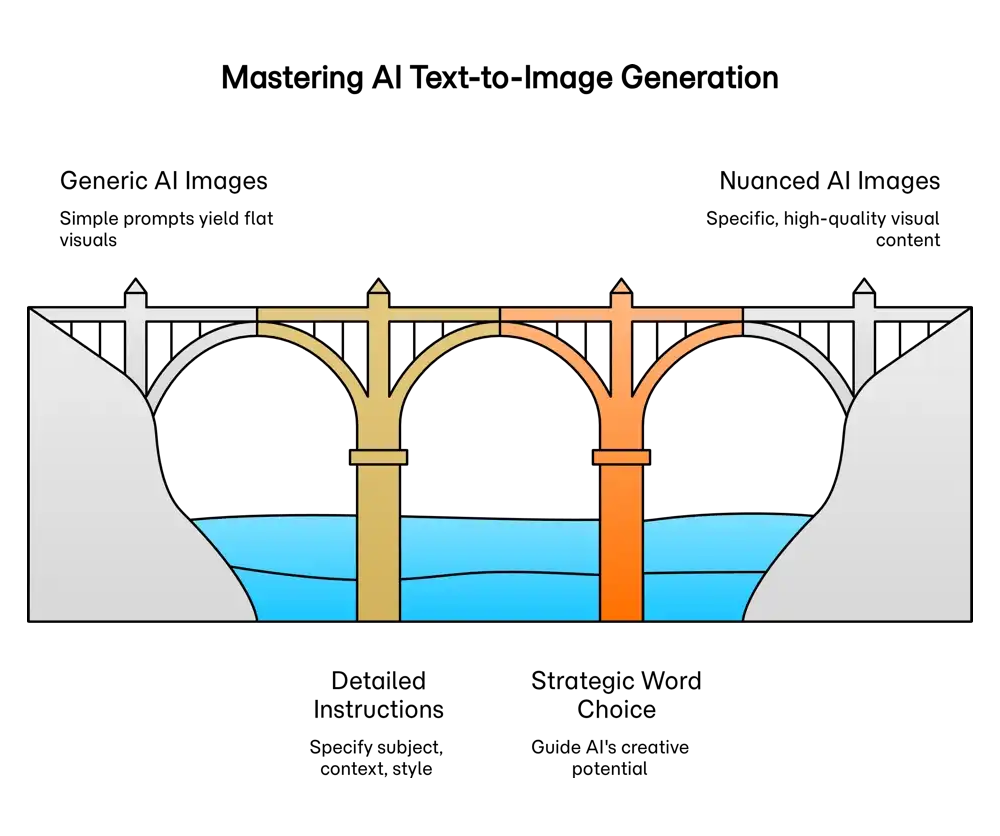
The relationship between textual prompts and the quality of AI-generated imagery is foundational. Vague commands lead to generic visuals, while detailed prompts, a practice known as prompt engineering, grant significant creative control. This involves strategically providing the AI with clear instructions on subject, context, style, composition, and lighting. Mastering prompt engineering transforms you from a passive user into an active director, guiding the AI’s creative potential to produce visuals that align precisely with your intent and reshaping how we interact with visual content across all professional fields.