Artificial intelligence has revolutionized digital art with text-to-image prompt generation, a technology that turns written descriptions into unique visual content. The key to unlocking its full potential lies in mastering the art of the prompt. By carefully selecting words related to style, medium, lighting, and composition, any creator can direct an AI to interpret a single concept in vastly different ways. This guide explores how to craft a prompt structure to achieve four distinct artistic styles, enabling a wide range of applications in art, fiction, and design.
From One Idea to Many Styles
The true power of AI image generation is its stylistic versatility. A simple concept, like "an astronaut looking at a nebula," can become a multiverse of visuals. Effective prompt engineering involves more than just describing the subject; it requires specifying the artistic direction. Let's explore how to generate photorealistic, cinematic, watercolor, and abstract styles from one core idea.
The Precision of the Photorealistic Style
Photorealism aims to produce images that are indistinguishable from high-resolution photographs. To achieve this, your prompts should include technical terms from photography. Mentioning specific camera settings, lens types, and lighting conditions tells the AI to focus on accuracy and detail. This approach is ideal for creating lifelike concept art or realistic product mockups. For even greater realism prompt, you can specify textures and even minor imperfections.
| Prompting Approach | Visual Characteristics | Creative Applications |
|---|---|---|
| Use keywords like "photorealistic," "ultra-detailed," "8K," and specific camera settings like "85mm lens," "f/1.8," "soft natural light." | Mimics a real photograph with accurate textures, natural lighting, and realistic depth of field. | Creating lifelike character portraits, realistic product visualisations, and marketing assets that look like professional photos. |
The Drama of the Cinematic Style
The cinematic style borrows from the visual language of filmmaking to create images with a narrative feel and emotional depth. Prompts for this style should include terms like "cinematic lighting," "dramatic shadows," "wide shot," and references to film genres or directors. Color grading terms such as "moody teal and orange colour grading" can further establish a specific tone. This style is perfect for storyboarding key scenes, designing evocative book covers, or creating promotional art with a strong narrative.
| Prompting Approach | Visual Characteristics | Creative Applications |
|---|---|---|
| Incorporate terms like "cinematic," "film still," "dramatic lighting," "anamorphic lens flare," "film grain," and "color grading." | Features high contrast, specific colour palettes like golden hour, neo-noir, and compositions that suggest a larger story. | Developing storyboards, creating compelling cover art for novels, and producing marketing materials with a narrative quality. |
The Delicacy of the Watercolor Style
To generate images with a soft, expressive, and handmade feel, use prompts that specify the watercolor medium. Keywords like "watercolor painting," "soft washes," and "visible brushstrokes" guide the AI to replicate the unique qualities of this traditional art form. You can get even more specific by mentioning techniques like "wet-on-wet," "pigment granulation," or "subtle paper texture" for a more authentic result. This style is excellent for children's book illustrations, custom stationery, or any project needing a touch of artistic charm.
| Prompting Approach | Visual Characteristics | Creative Applications |
|---|---|---|
| Use descriptors like "watercolor painting," "gouache," "soft wet-on-wet," "delicate brushstrokes," and "paper texture." | Exhibits translucent colors, gentle gradients, and the characteristic bleeding edges of watercolor paint. | Illustrating books, designing unique greeting cards, and adding a handcrafted aesthetic to digital content. |
The Expressiveness of the Abstract Style
Abstract art prioritises emotion and concept over literal representation. Prompts for this style should focus on feelings, themes, or visual elements like shapes and colors rather than a specific scene. For example, a prompt could be "an image abstraction of loneliness and wonder, with swirling colors and fragmented shapes." This approach allows for a highly interpretive and emotionally driven result, making it useful for creating unique graphic design assets, thought-provoking art, or visual metaphors for complex ideas.
| Prompting Approach | Visual Characteristics | Creative Applications |
|---|---|---|
| Focus on concepts, emotions, and forms with keywords like "minimalist abstract," "geometric patterns," "vibrant colour splashes," or emotional cues like "serene" or "chaotic." | Employs color, shape, and texture to create a non-representational composition that is open to interpretation. | Generating unique backgrounds, creating expressive art pieces, and visually representing complex themes in design projects. |
A New Era of Creative Collaboration
The ability to direct AI through stylistic prompts marks a significant shift in the creative process. This form of creative prompting allows artists, writers, and designers to rapidly prototype ideas and explore visual directions with unprecedented speed. AI text-to-image generation acts as a powerful collaborative partner, expanding the creative possibilities for visual storytelling and democratizing art creation for everyone.
Ready to transform your AI into a genius, all for Free?
Create your prompt. Writing it in your voice and style.
Click the Prompt Rocket button.
Receive your Better Prompt in seconds.
Choose your favorite AI model and click to share.
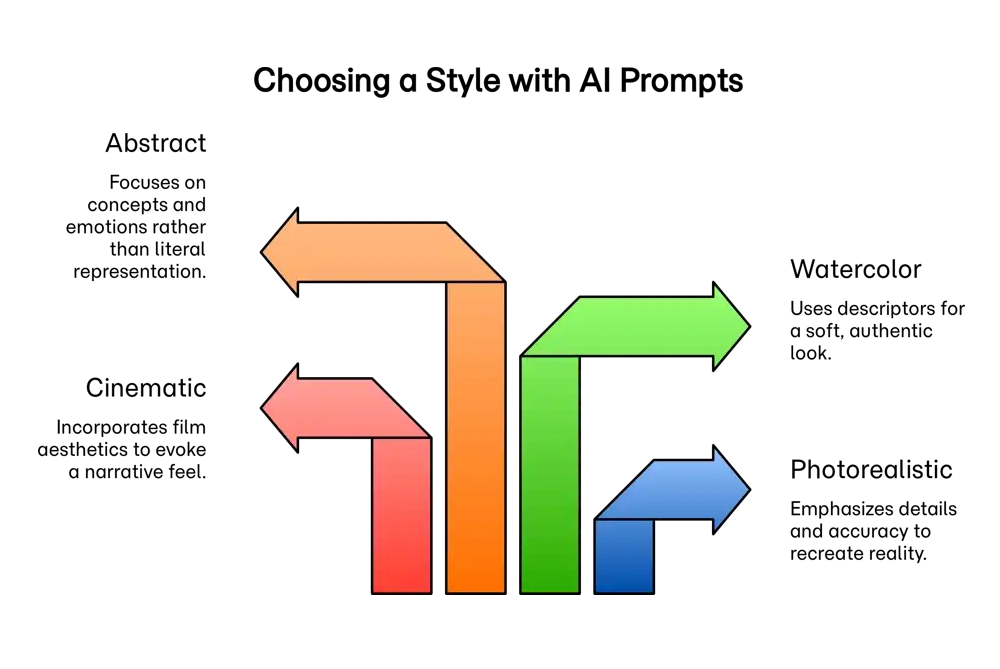
Summary of Choosing a Style with AI Prompts
AI image prompting allows for the creation of a multitude of visual interpretations from a single conceptual idea. This technology enables artists, writers, and creators to explore diverse applications of digital art by specifying styles such as photorealistic, cinematic, watercolor, and abstract. A prompt can be meticulously crafted to generate a highly realistic image that mirrors photography, complete with specific lighting and camera details. The same core idea can be transformed into a dramatic, film-like scene by adding terms like "cinematic lighting" and "wide shot." Shifting the prompt to include "watercolor" and descriptors of its unique characteristics, like "soft wet-on-wet" and "pigment pooling," can produce an image with the delicate and translucent qualities of the traditional medium. For a more conceptual representation, prompts for abstract art can be used to convey emotions or ideas through non-representational forms and colors. These varied visual outputs serve numerous creative purposes, from providing visual inspiration and concept art for fiction writers to generating unique marketing materials and personal creative projects.