
The practice of prompting better is about writing a better English instruction to unlock your AI’s full potential. This means moving beyond conversational language and adopting a method that fosters English-trained reasoning and effective problem solving through solid prompt engineering. Whether you are working with large language models, exploring Natural Language Processing, or utilising predictive-AI, understanding what is a prompt is your first step to success.
The Fundamentals of Prompting Better
To start prompting better, you must focus on prompt clarity and prompt structure. A neutral prompt is objective, factual, and free from bias. Because context is king, providing clear context background and unambiguous system instructions guides the AI toward a logical deductive process, significantly reducing the chance of hallucinations or stochastic parroting. Whether you are using zero-shot or few-shot techniques, transforming spoken language into precise instructions is key. Define the task, set the format, and establish clear personas to avoid the garbage in, garbage out dilemma.
Search AI Articles
- Prompt Anxiety
- How do I overcome the fear of writing a bad AI prompt?
- Prompt anxiety is the feeling of overwhelm or hesitation users experience when trying to craft a better English AI prompt. It often stems from a lack of confidence or fear of poor results. Overcoming it requires embracing iterative refinement and viewing prompting as a collaborative exploration rather than an exact science.
- AI intimidation
- iterative prompting
- prompt confidence
- beginner tips
- AI exploration
- Prompt Checklist
- What essential elements should be included in a standard prompt checklist?
- A prompt checklist is a structured set of guidelines used to ensure an AI prompt includes all necessary components before submission. Covering elements like role, task, context, and output format, a checklist helps maintain consistency, improves output quality, and reduces the need for constant reprompting.
- prompt structure
- quality assurance
- prompting guidelines
- AI output format
- prompt engineering
- Chain of Thought (CoT)
- How do I write a Chain of Thought prompt to improve AI logic?
- Chain of Thought (CoT) prompting instructs the AI to break down complex problems into logical, step-by-step reasoning sequences before answering. By explicitly asking the model to "think aloud," it significantly improves accuracy in math, logic, and multi-step reasoning tasks by mimicking human deduction.
- step-by-step reasoning
- zero-shot CoT
- logical deduction
- AI problem solving
- reasoning capabilities
- Negative Prompting
- How do I effectively use negative prompts to exclude unwanted AI outputs?
- Negative prompting involves explicitly instructing an AI on what not to include in its output. While widely used in image generation to remove unwanted artifacts, it is equally effective in text models to prevent clichés, restrict certain tones, or avoid specific topics.
- exclusion criteria
- AI image generation
- output restriction
- negative weights
- boundary setting
- Prompting like Code
- How can I structure my AI prompts like programming code for better reliability?
- This philosophy suggests that writing AI prompts should be treated with the same precision and logic as software programming. It emphasises using variables, logical flow, structured formats like JSON, and modular design to create robust, repeatable, and scalable interactions with language models.
- pseudocode prompting
- variables in prompts
- algorithmic thinking
- structured data
- prompt syntax
- Prompt Specificity
- Why is adding specific details crucial for generating accurate AI responses?
- Prompt specificity is the degree of precise detail provided to an AI model to narrow down the scope of its response. High specificity eliminates ambiguity by defining exact parameters, target audiences, and formats, serving as the most direct way to reduce AI hallucinations.
- precision prompting
- eliminating ambiguity
- targeted output
- AI hallucinations
- detailed parameters
- Context is King
- How much background context should I provide to an AI for the best results?
- "Context is King" highlights the critical importance of providing background information or situational framing within a prompt. Without context, AI models generate generic responses. Feeding the AI relevant context allows it to ground its knowledge, tailor its tone, and produce highly personalised outputs.
- background information
- grounding AI
- situational awareness
- contextual framing
- personalised outputs
- Multimodal Prompting
- How do I combine text and images effectively in a multimodal AI prompt?
- Multimodal prompting involves interacting with AI models using multiple types of data simultaneously, such as combining text, images, audio, and video. This allows users to ask questions about uploaded images or summarise audio files, dramatically expanding the AI's utility and comprehension.
- image-to-text
- computer vision
- cross-modal AI
- multimodal interaction
- media inputs
- Prompt Constraints
- What are the best ways to set strict constraints to control AI behavior?
- Prompt constraints are strict rules and boundaries set within a prompt to limit the AI's behavior. Examples include defining word counts, forbidding certain words, or enforcing a specific tone. Constraints force the AI to be creative within boundaries, ensuring adherence to user requirements.
- rule setting
- output limitations
- boundary conditions
- formatting rules
- AI control
- Prompt COSTAR
- What does the COSTAR prompting framework stand for and how do I use it?
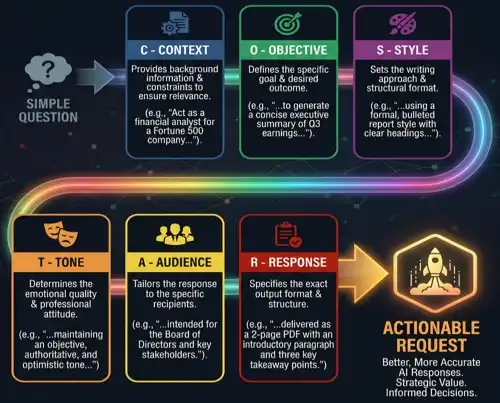
- COSTAR is a prompt engineering framework standing for Context, Objective, Style, Tone, Audience, and Response. It provides a comprehensive template to help users structure their prompts systematically, ensuring the AI has all necessary parameters to generate highly targeted and well-crafted content.
- COSTAR framework
- prompt templates
- objective setting
- audience targeting
- structured prompting
- RISEN Framework
- The RISEN framework is a prompt structuring technique standing for Role, Instructions, Steps, End Goal, and Narrowing. It is highly useful for task-oriented prompting, guiding the AI through a logical sequence by defining its persona, exact steps, desired outcome, and limitations.
- How can the RISEN framework improve task-oriented AI prompting?
- RISEN formula
- role-playing AI
- step-by-step instructions
- goal-oriented prompting
- prompt constraints
- CREATE Framework
- How do I use the CREATE framework to generate better AI copywriting?
- The CREATE framework optimises AI prompt creation by focusing on Character, Request, Examples, Adjustments, Type of output, and Extras. This methodology relies heavily on providing few-shot examples and iterative adjustments, making it excellent for nuanced tasks like copywriting or mimicking brand voices.
- CREATE formula
- few-shot prompting
- output typing
- iterative adjustments
- brand voice
- DEPTH Framework
- What are the components of the DEPTH prompt engineering framework?
- The DEPTH framework is a strategy for writing comprehensive prompts, focusing on Detail, Example, Persona, Task, and Harmony. It is particularly effective for generating deep, analytical, or long-form content by combining detailed task descriptions with specific examples and a matching tone.
- DEPTH methodology
- long-form content generation
- persona building
- task harmony
- analytical prompting
- The English Prompt
- Is there a universal formula for writing a better English AI prompt?
- "The Perfect Prompt" represents the idealised instruction that yields the exact desired result on the first try. While a universally perfect prompt rarely exists, approaching it requires a blend of clear context, specific constraints, well-defined roles, and structured formatting tailored to the specific model.
- optimal prompting
- prompt optimisation
- first-try results
- prompt anatomy
- AI mastery
- Automated Refinement
- How can I use AI to automatically rewrite and improve my own prompts?
- Automated prompt refinement involves using AI to improve, expand, or optimise a basic prompt. Instead of manually tweaking instructions, users ask the AI to rewrite the prompt to be more effective, leveraging the model's understanding of its own architecture to maximise output quality.
- meta-prompting
- prompt optimisation
- self-correction
- AI-assisted prompting
- prompt expansion
- Prompt Cost Optimisation
- What are the best strategies to reduce token usage and save API costs?
- Prompt cost optimisation is the practice of engineering prompts to minimise token usage without sacrificing quality. Techniques include being concise, minimising unnecessary context, and requesting efficient data formats like JSON to keep API billing costs low during high-volume operations.
- token economics
- API cost reduction
- concise prompting
- efficiency
- token management
- Maximising Prompt Reliability
- How do I write a prompt that gives consistent results every time I use it?
- Maximising reliability ensures an AI model produces consistent and predictable results across multiple runs. This involves eliminating ambiguous language, setting strict parameters, utilising clear formatting instructions, and providing exhaustive edge-case handling so the AI does not deviate from the expected structure.
- consistent outputs
- deterministic AI
- edge-case handling
- predictable prompting
- robustness
- Prompt Middleware
- What is prompt middleware and how does it help scale AI applications?
- Prompt middleware refers to software layers that sit between the user interface and the underlying AI model. It manages prompt routing, template injection, moderation, and variable insertion, helping developers scale applications, secure prompts, and manage versions without altering core application logic.
- AI infrastructure
- prompt management
- dynamic variables
- API routing
- prompt security
- Prompt Vibe Check
- How do I adjust a prompt to perfectly capture a specific brand vibe or tone?
- A "Prompt Vibe Check" is a colloquial term for testing the subjective tone, style, and emotional resonance of an AI's output. It involves iterating on a prompt to ensure the AI captures the right personality, whether witty, professional, or empathetic before deployment.
- tone of voice
- stylistic alignment
- emotional resonance
- brand persona
- subjective testing
- Prompt Future-Proofing
- How can I ensure my prompts still work when AI models get updated?
- Prompt future-proofing is the strategy of designing prompts that remain effective even as underlying AI models are updated. It focuses on writing clear, foundationally sound instructions based on general linguistic logic rather than exploiting model-specific quirks, ensuring long-term application stability.
- model-agnostic prompting
- technical debt
- prompt stability
- foundational logic
- AI updates
- Consulting Strategy
- How can our business integrate AI effectively to achieve strategic goals and maximise ROI without disrupting existing workflows?
- Consulting strategy involves assessing a company's current operations to develop a comprehensive roadmap for AI adoption. This includes identifying high-impact use cases, selecting appropriate AI tools, aligning technology with business objectives, and managing organisational change to ensure sustainable growth and a competitive advantage in the market.
- AI Strategy
- Business Transformation
- ROI Optimisation
- Digital Transformation
- Strategic Planning
- Technology Adoption
- AI Auditing
- How do we ensure our AI systems are unbiased, secure, compliant with industry regulations, and performing accurately?
- AI auditing is the systematic evaluation of artificial intelligence models and workflows to ensure they operate ethically, securely, and effectively. This process reviews algorithms for bias, verifies compliance with legal standards, assesses data privacy measures, and tests overall system reliability to mitigate risks and build trust with stakeholders.
- Algorithmic Bias
- AI Compliance
- System Evaluation
- Risk Management
- AI Ethics
- Security Assessment
- Writing a Prompt Library
- How do we create, organise, and maintain a centralised repository of effective AI prompts for our entire team?
- Writing a prompt library involves curating and documenting highly effective, reusable AI prompts tailored to a company's specific needs. It provides a structured resource that standardises AI interactions, improves team productivity, ensures consistent outputs, and reduces the learning curve for employees using generative AI tools.
- Prompt Engineering
- Knowledge Management
- Generative AI
- Output Consistency
- Team Productivity
- Prompt Optimisation
- Consulting and Training
- What is the best way to upskill our workforce so they can confidently and securely use AI tools?
- AI consulting and training bridge the knowledge gap by equipping teams with the skills needed to leverage artificial intelligence. It combines strategic guidance with hands-on workshops, focusing on best practices, tool proficiency, and practical applications, empowering employees to innovate and increase their everyday operational efficiency.
- Workforce Upskilling
- Corporate Training
- AI Education
- Change Management
- Technology Workshops
- Employee Empowerment
- AI Privacy Advice
- How can we use generative AI tools without exposing sensitive company data or violating customer privacy regulations?
- AI privacy advice provides organisations with critical guidelines on protecting sensitive data while utilising artificial intelligence. This includes navigating data protection laws, implementing secure data handling practices, preventing accidental data leaks into public models, and establishing internal policies to ensure safe and confidential AI usage.
- Data Security
- GDPR Compliance
- Confidentiality
- AI Governance
- Data Protection
- Information Security
Ready to transform your AI into a genius, all for Free?
Start with your idea, written in your own voice and style.
Click the Prompt Rocket button to optimise.
Receive your new, neutral Better Prompt in seconds.
Choose your favorite AI model and click to share.
Who is Betterprompt for?
Betterprompting is a critical skill for anyone who relies on AI for accurate and insightful answers. We are for the questioners who haven’t found the right answers, for the researchers buried in data, and for the prompt engineer seeking to maximise performance and achieve cost optimisation. Betterprompt is designed for people and teams who want better AI results by communicating with clarity and precision. From are code developers to marketers needing specifically tailored content, mastering the natural-language bottleneck is essential.
| Role | Position | Unique Selling Point | Flexibility | Problem Solving | Saves Money | Solutions | Summary | Use Case |
|---|---|---|---|---|---|---|---|---|
| Coders | Developers | Unleash your 10x | No more hopping between agents | Reduce tech debt & hallucinations | Get it right 1st time, reduce token usage | Minimises scope creep and code bloat | Generate clear project requirements | Merge multiple ideas and prompts |
| Leaders | Professionals | Be good, Be better prompt | No vendor lock-in or tenancy, works with any AI | Reduces excessive complementary language | Prompt more assertively and instructively | Improved data privacy, trust and safety | Summarise outline requirements | Prompt refinement and productivity boost |
| Higher Education | Students | Give your studies the edge | Use your favourite, or try a new AI chat | Improved accuracy and professionalism | Saves tokens, extends context, it’s FREE | Articulate maths & coding tasks easily | Simplify complex questions and ideas | Prompt smarter and retain your identity |
Advanced Frameworks for Prompting Better
To truly master the craft, consider adopting proven frameworks. Using the COSTAR, RISEN framework, CREATE framework, or DEPTH framework helps structure your inputs systematically. Additionally, applying chain-of-thought reasoning encourages the AI to break down complex problems step-by-step. Don't forget the power of negative prompting and setting constraints to explicitly tell the AI what to avoid, ensuring better reliability. For ongoing improvement, rely on iterative refinement and vibe checks.
Mastering Image Generation Prompts
Prompting extends far beyond text. When working with image generation and diffusion models, specificity is vital. Whether you are aiming for stunning realism, image abstraction, or vintage aesthetics, you need to guide the AI carefully. Learn how to handle imperfections like anatomical distortions or issues with rendering hands. For professionals, mastering photo editing, inpainting, and outpainting can revolutionize internal business content, for advertising, and for marketing. You can even generate professional head shots or explore interior design concepts.
AI Safety, Privacy, and Optimisation
As you scale your AI usage, understanding AI-safety becomes paramount. Concepts like reinforcement learning from human feedback and keeping a human in the loop ensure outputs remain aligned with your goals. Be aware of vulnerabilities like injection and jailbreaking, and employ layered security. To maximise efficiency, utilise optimizers, adjust the temperature and top-p settings in your sandboxes and playgrounds, and consider automated refinement for future proofing your workflows.